Tampilkan postingan dengan label Ethiopia. Tampilkan semua postingan

Rabu, 03 Juli 2013

ILRI publishes report on rapid appraisal of Ethiopia's live cattle and beef value chain

Cattle market in Mi'eso area
Cattle market in Mi'eso, Oromia Region, Ethiopia (photo credit: ILRI/Apollo Habtamu).


Despite the prominence of cattle in Ethiopian society and its economy, relevant qualitative and quantitative information is both scarce and subject to a variety of interpretations.

Mobilizing cattle, and their supporting natural and human resource base, in a sustainable manner for development purposes is therefore a challenge that begins with identification of problems and opportunities about which there is limited agreement.

It is in this context that the Government of Ethiopia requested a diagnostic study, through the Bill & Melinda Gates Foundation, which is supporting the Ethiopian Ministry of Agriculture and Rural Development to undertake a work program requested by the government, to provide strategic input and technical assistance in several key areas of the country’s agricultural sector.

Using an extensive review of secondary materials, learning from a series of stakeholders’ consultations, and participatory rapid assessments of market actors, the study analyzed live cattle and beef marketing.

The key findings have been published by the International Livestock Research Institute (ILRI) in a discussion paper.

The rapid appraisal focused on two of Ethiopia’s major cattle trading routes, representing each of the agropastoral highland production systems and pastoral lowland production, and the respective routes taken by animals to market.

The main objective was to diagnose problems based on quantitative measures, and identify associated policy strategies. The study team included local specialists, international management consultants, as well as researchers from CGIAR.

The team not only interacted with the policymakers on emerging results but also triangulated the results with other experts in the country in the forms of both stakeholders’ consultations and one-to-one interviews.

Rabu, 14 November 2012

Good livestock management by all value chain actors can improve quality in the Ethiopian leather industry


Jean Joseph (Jo) CadilhonJo Cadilhon (left) recently joined the International Livestock Research Institute as an agricultural economist with the Changing Demand and Market Institutions team. From 6-9 November 2012, he was among several scientists and other agricultural stakeholders who took part in an international conference organized by CTA in Addis Ababa, Ethiopia under the theme “Making the connection: Value chains for transforming smallholder agriculture”. He facilitated a session on capacity building in value chains and later during one of the conference field trips learned about an important value chain for livestock by-products: the Ethiopian leather industry. Below is his report.

The International Livestock Research Institute (ILRI) was a partner organizer of the CTA conference on Making the connection: value chains for transforming smallholder agriculture held from 6 to 9 November 2012 in Addis Ababa, Ethiopia.

One of the conference field trips organized by the United Nations Industrial Development Organization (UNIDO) focused on leather products so I joined it to discover this value chain for livestock by-products.

I learned that good management practices by all stakeholders in the chain are just as critical for the quality improvement of livestock by-products as it is for the quality and safety of food products derived from livestock.

Take the example of the leather industry in Ethiopia. Although selling animal hides for leather production is only a by-product for livestock producers, the local tanning industry can process up to 30,000 skins per day, producing leather for shoes and garments and creating significant employment, according to the Leather Industry Development Institute.

Cattle being watered at the Ghibe River in southwestern Ethiopia
Cattle being watered at the Ghibe River in southwestern Ethiopia. Simple improvements in the practices of livestock value chain stakeholders, such as avoiding inflicting wounds on the skin of cattle during herding, could help improve the quality of Ethiopian leather goods. (photo credit: ILRI/Stevie Mann).

Crucially, simple improvements in herding, slaughtering, skinning and marketing practices in livestock value chains could help improve the quality of finished leather goods and thus increase the incomes for all value chain stakeholders.

For example, men’s shoes are cut out of cow skins. The various components of the shoes are cut from different areas of the skin: the shoulder and butt being stronger and of better quality than the skin from the belly and legs.

The job of the leather cutter is to optimize the number of shoe parts that can be cut out of one hide. If there are holes in the hide due to putrefaction of the skin before tanning, this decreases the number of shoe parts that can be cut out of one hide.

These holes are due to infected wounds in the skin. These wounds are usually inflicted on the animal during herding, slaughtering and skinning of the slaughtered animal.

Furthermore, there are usually several days before a hide reaches the tannery from the slaughterhouse through a very long chain of intermediary traders whereas the optimal time to preserve the quality of animal hides before tanning is just 24 hours.

This long time lag increases the likelihood of putrefaction of any wounds on the hides, thus decreasing the quality of the leather.

One indicator of leather quality is the homogeneity of the leather’s surface. When the live animal has been sick or infected by parasites scars and spots can appear on the skin, which then lead to stains and scars on the tanned leather.

The leather cutters and cobblers then have to work around these defects for fear of seeing the price of the final product depreciated.

Quality improvement in the Ethiopian livestock and leather industry is supported by ILRI,  the Italian Development Cooperation, the United Nations Development Program (UNDP), UNIDO and the United States Agency for International Development (USAID) through linkages with the Leather Industry Development Institute.

Rabu, 29 Agustus 2012

ILRI presents at the 28th International Conference of Agricultural Economists

Cattle being watered at the Ghibe River in southwestern Ethiopia
Cattle being watered at the Ghibe River in southwestern Ethiopia. The country's livestock sector supports the livelihoods of a large proportion of rural households (photo credit: ILRI/Stevie Mann).

On 18-24 August 2012, some 1000 agricultural economics experts from around the world met in Foz do IguaƧu, Brazil for the 28th triennial International Conference of Agricultural Economists. The conference was organized by the International Association of Agricultural Economists (IAAE).

Under the theme, The Global Bio-Economy, the conference discussed several global challenges affecting the bio-economy, including food insecurity, natural resource management and food price crises, and possible ways of addressing these challenges.

A team of researchers from the International Livestock Research Institute (ILRI) attended the meeting and presented papers on various aspects of agricultural economics in developing countries, including the role of livestock in the Ethiopian economy, the competitiveness of smallholder pig producers in Vietnam and economic impact assessment of avian influenza control measures in Nigeria.

Other presentations covered the opportunities for intra-regional trade in staple food crops in the Common Market for Eastern and Southern Africa (COMESA) region, the effects of decentralized forest management on household farm forestry in Kenya and the Gender, Agriculture and Assets Project, a research initiative jointly led by the International Food Policy Research Institute (IFPRI) and ILRI aimed at better understanding gender and asset dynamics in agricultural development programs.

Selasa, 20 Desember 2011

ILRI project uses innovation systems approach to strengthen capacity for community-based animal health systems in Ethiopia

Cattle being watered at the Ghibe River in southwestern Ethiopia
Cattle being watered at the Ghibe River in southwestern Ethiopia. An ILRI-led project has helped strengthen the capacity of local communities to use innovation system approaches towards better access to animal health services (photo credit: ILRI/Mann).


A collaborative project led by scientists from the International Livestock Research Institute (ILRI) has strengthened the capacity of local communities in Ethiopia’s Ghibe Valley to use innovation systems approaches to improve access to animal health systems.

The Ghibe Valley in southwestern Ethiopia is a fertile region whose rich soils and abundant water resources suggest high agricultural production potential.

However, the region is seriously affected by the deadly trypanosomosis (animal sleeping sickness), a wasting cattle disease which affects the livelihoods of smallholder farmers who depend on livestock for milk, meat and draught power.

In order to enhance the community’s access to animal disease control services, the project tested a collaborative trypanosomosis control model in three woredas (administrative units managed by local government).

The project, which was led by ILRI’s Innovation in Livestock Systems research team, used two action research approaches – asset-based community development and innovation systems – to derive lessons on how to sustainably improve livestock health service delivery and how to translate improved livestock health into increased productivity and incomes.

Thirteen trypanosomosis co-operatives were formed to link private veterinary drug suppliers to the remote communities to ensure sustainable supply of trypanocides to farmers and reduce dependence on the central government system.

The rural communities have been communicating their needs directly to the private drug suppliers in the capital city Addis Ababa and supply mechanisms have been established.

The project produced a guideline in the local Amharic language for collaborative trypanosomosis control for use by community animal health workers in various districts and regions affected by the disease.

The project also shared maps based on the tse tse fly habitat and trypanosomosis risk modelling of Ghibe Valley with the district and regional authorities for their use in targeting disease-control investments in high-risk and “hot spot” areas.

Other regions which face trypanosomosis challenge have been informed of the utility of such information and analysis for directing investments for effective trypanosomosis control.

These interventions have resulted in significant changes in land use and land cover, increased cultivation of staple crops and healthier, more productive cattle.

The four-year project, which ended in August 2011, was funded by the Comart Foundation.

For more information, please contact Dr Ranjitha Puskur (r.puskur @ cgiar.org) who leads ILRI's research team on Innovation in Livestock Systems.

Jumat, 09 Desember 2011

Traditional fermentation holds the key to microbial safety of milk in Ethiopia, ILRI study finds

Dairy farming in Ethiopia
An Ethiopian smallholder dairy farmer with the day's milk.  An ILRI study reports that traditional fermentation of milk in Ethiopia can significantly reduce the risk of staphylococcal food poisoning (photo credit: ILRI).


The safety of milk and dairy products in Ethiopia can be significantly improved through participatory risk assessment approaches to traditional methods of food production, reports a study published in the 4 November 2011 issue of the International Journal of Food Microbiology.

The study was carried out to assess the risk of staphylococcal poisoning through traditionally fermented milk in Debre Zeit, Ethiopia. Staphylococcus aureus is a bacterium that can cause mastitis (udder infection) in dairy cows. It can also cause food poisoning through production of an enterotoxin.

Traditional souring of milk is carried out by leaving raw milk in a gourd to ferment spontaneously for 1-2 days through the action of the naturally occurring milk microflora. The organic acids produced during fermentation inhibit the growth of spoilage micro-organisms, thereby prolonging the storage life of the milk.

The study, which is part of research by the BMZ- funded Safe food, fair food project, found that home-made traditionally fermented milk in Debre Zeit, Ethiopia reduced the risk of food poisoning by Staphylococcus aureus by 93.7%.

The research was collaboratively undertaken by scientists from the Market Opportunities Theme of the International Livestock Research Institute (ILRI) and Addis Ababa University.

Principal author Dr Kohei Makita is a veterinary epidemiologist on joint appointment with ILRI and the Rakuno Gakuen University in Japan while co-author Dr Delia Grace is a veterinary epidemiologist and leader of ILRI's research team on Animal health, food safety and zoonoses.

Read the abstract of the journal article here.

Citation
Makita K, Dessisa F, Teklu A, Zewde G and Grace D. Risk assessment of staphylococcal poisoning due to consumption of informally-marketed milk and home-made yoghurt in Debre Zeit, Ethiopia. International Journal of Food Microbiology (2011), doi:10.1016/j.ijfoodmicro.2011.10.028

Jumat, 28 Oktober 2011

International conference to discuss strategies to boost agricultural productivity and food security in Africa

Working in the maize field in Malawi
A Malawian farmer tends to her maize crop. Farmer organizations will be among participants at an international conference on improving agricultural productivity for achieving food security in Africa. The conference takes place in Addis Ababa, Ethiopia on 1-3 November 2011 (photo credit: ILRI/Mann).


Farmers, researchers, policymakers, academics and development partners are among some of the participants who will gather at the United Nations Conference Centre in Addis Ababa, Ethiopia on 1-3 November 2011 for an international conference under the theme, Increasing agricultural productivity and enhancing food security in Africa: New challenges and opportunities.

The conference is organized by the International Food Policy Research Institute (IFPRI), in conjunction with the African Union Commission, the Forum for Agricultural Research in Africa (FARA) and the United Nations Economic Commission for Africa (UNECA) and will feature plenary and parallel sessions, discussions of conference papers, and moderated panel discussions of specific issues.

Scientists from the Market Opportunities Theme of the International Livestock Research Institute (ILRI) are scheduled to present two papers during the parallel session on 'Appropriate capacities, investments, institutions and policies for supporting agriculture'.

Ayele Gelan will present a paper titled, Integrating livestock in the CAADP framework: policy analysis using a dynamic computable general equilibrium model for Ethiopia and Francis Wanyoike will present on Pro-poor livestock development: analysis of performance of projects and lessons.

To find out more about the conference, please visit http://addis2011.ifpri.info

Selasa, 27 September 2011

Study explores market opportunities for value-added beef products in East Africa

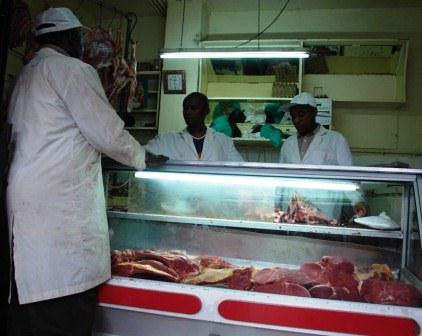
Selling meat in a Kenyan butchery. Improving the quality and safety of beef sold by small-scale traders in East Africa will enable them take advantage of emerging niche markets and increase their incomes. (Photo: ILRI)

According to a May 2011 report by the International Food Policy Research Institute (IFPRI), annual meat consumption per person will more than double in sub-Saharan Africa from 2000 to 2050, leading to a doubling of total meat consumption by 2050.

The Food and Agriculture Organization (FAO) estimates that between 1997-99 and 2030, annual meat consumption in sub-Saharan Africa (excluding South Africa) will increase from 9.4 to 13.4 kg per person.

Growth in human population, increasing incomes and changing consumer tastes are among the main drivers of this rise in demand for high-quality meat products in much of the developing world, a trend that is expected to continue.

In eastern Africa, the growing demand for high-quality meat products presents a ripe opportunity for livestock producers to take advantage of the emerging markets for value-added meat products. However, several institutional barriers, such as unfavourable policies and poorly enforced regulations, limit the extent to which small-scale meat producers and market agents in the region can benefit from these opportunities.

To address this and other related issues, a collaborative project, Exploiting market opportunities for value-added dairy and meat products in the Eastern and Central Africa region, was carried out in Ethiopia, Kenya and Tanzania in 2006 and in Rwanda, Uganda and South Sudan in 2010 to characterize value chains for conventional and niche markets for dairy and meat products.

The project aimed at enhancing the capacity of small- and medium-scale enterprises in the East Africa region to effectively meet consumer demand for safe, high-quality dairy and meat products that meet national regulatory requirements.

The study examined consumers' perspectives on meat quality and safety and found that high-income consumers prefer to buy meat from upper-end markets like priority stores and supermarkets. They associate well packaged meat, clean premises and veterinary stamped-products with good quality and safety, and are indeed willing to pay a premium for these attributes. On the other hand, low-income consumers mostly purchase their meat products from local butcheries.

Roast beef

Selling of roast beef is an increasing trend motivated by rising consumer demand for ready-to eat roast beef. For example, in Kenya, Tanzania and South Sudan, the roast meat (nyama choma) sold in butcheries and bars is a growing preference by both the indigenous and foreign consumers. In Uganda, vending of roadside roast beef known as muchomo is a growing trend on highway spots outside the capital city, Kampala.

The different ways in which the beef is roasted, dressed and sold varies by country. However, some consumers still question the safety and quality of beef as it goes through the processes of roasting, dressing and selling. However, if sellers can provide assurance of quality and safety then there will be demand from the high-income consumers.

Therefore, to increase the sales of value-added products, sellers of roast beef should adhere to national regulations for quality and safety and respond to consumer preferences. The growing trend of niche markets running along the spectrum of high, medium and low income consumers should also be explored as an opportunity for increasing sales through product value addition.

Regulators and policy perspectives

With regard to the policy and regulatory environment, the study identified a need for greater harmonization of regulations among countries in the eastern Africa region in order to enhance effective service provision to the beef sector.

The study proposes that a comprehensive beef policy for the region be drawn up to guide the implementation and enforcement of regulations aimed at ensuring the quality and safety of beef products, particularly those sold by small-scale traders.

For more information about this study, please contact Dr Amos Omore of the International Livestock Research Institute (ILRI) (a.omore @ cgiar.org).

Story adapted from a brochure, Quality and safety of small-scale beef products in East and Central Africa, produced by the Association for Strengthening Agricultural Research in Eastern and Central Africa (ASARECA).

Senin, 19 September 2011

Study examines quality and safety of East Africa's milk and dairy products

Training and certification schemes for small-scale sellers of milk and dairy products in Eastern Africa can lead to better milk quality and help traders benefit from the growing demand for value-added dairy products. (Photo: ILRI)
Most sub-Saharan countries, including those in Eastern and Central Africa, are net importers of dairy products, with most of these products being imported from Europe and South Africa. In South Sudan, nearly all value-added dairy products are imported. At the same time, there is a growing demand for high-quality dairy products by the growing population and the tourist market.

The unmet demand is providing opportunities for value addition. However, significant technical and institutional barriers continue to limit the exploitation of these benefits by small-scale producers and small- and medium-scale enterprises engaged in value addition activities.

A study characterizing value chains for both conventional and niche markets for dairy and meat products was carried out in Ethiopia, Kenya and Tanzania in 2006 and in Rwanda, Uganda and South Sudan in 2010.

The main objective of the project, Exploiting market opportunities for value-added dairy and meat products in the Eastern and Central Africa region, was to enhance the capacity of small- and medium-scale enterprises to meet demand for quality and safety of the various value chain actors and regulatory requirements.

Major concerns and opportunities for value addition are presented here to stimulate action by producers, processors and traders on key issues regarding the quality and safety of milk and dairy products produced and marketed by small and medium enterprises in the eastern Africa region.

Consumer perceptions 

The issue of milk quality evokes different perceptions and reactions among different categories of consumers. Over 80% of the milk is sold raw (unpasteurized). Colour, smell, thickness, perceived fat content and cleanliness of the milk handlers, milk vessels and premises from where milk is sold are some of the most important criteria used by those purchasing raw milk.

Adulteration of milk, often judged by observations on thickness and physical appearance, is a major food safety concern to consumers, counter-balanced only by personal judgment and mutual trust between buyer and seller. Most adults consume fresh milk in the form of tea or makyato (Ethiopia) while children drink fresh milk directly after boiling.

The quality of packaging, presence of quality certification mark, expiry date and reliability of supplier are very important considerations to consumers who buy value-added dairy products such as pasteurized milk, yoghurt, fermented (sour) milk, cheese and butter.

More than 50% of consumers interviewed considered the quality of packaging to be an important measure of the quality and safety of products they bought and would be willing to pay more for well-packaged milk. This is not surprising as most of them were already purchasing considerably more expensive but better packaged imported dairy products.

Between the milk producers and consumers, various market intermediaries including informal milk traders, vendors, hawkers and formal dairy chain actors such as co-operative societies and processors play various roles in transforming milk into value-added products.

All processors consider milk producers as their primary clients. The primary concern of the informal traders is the quantity of milk supplied to them which can vary a lot by season, especially where traditional pastoralists are the major suppliers. Adulteration with water is a common problem especially in the dry season.

Milk quality

The main concern of the organized sector in all the six countries is the quality and hygienic level of milk handling. The use of plastic vessels for carrying milk is a major source of contamination as they are often poorly designed, not made of food-grade material and difficult to clean.

Most processors use lactometers to exclude heavily adulterated milk with a common lactometer reading cut-off point of 26. Seasonal fluctuation in the quantity, quality and prices of raw milk is yet another area of concern for processors.

Large hotels and supermarkets often demand quality and safety for value added products that are properly and attractively packaged and are endorsed by quality control bodies such as national bureaus of standards. Some high-end supermarkets demand packaged products to have bar codes for ease of sales and stock control.

Very few small- and medium-scale enterprises meet these demands for quality and safety. In some cases, there were poorly designed or inappropriately, inadequately, or erroneously labelled containers and wrappings of butter and cheese.

These shortcomings have tended to degrade the quality and safety perception of such products by potential buyers or, more importantly, acted as barriers to accessing high-end supermarket shelves in some of the major cities of the six countries.

All countries have food standards bodies and regulations that prescribe hygienic and food safety standards for milk and dairy products. Nevertheless, informal trade in raw milk is predominant in all countries and compliance by small- and medium-scale enterprises is still low.

High fees for quality testing and certification; lack of quality control facilities; the high cost of packaging materials; high cost of appropriate milk handling equipment such as milk cans and milk coolers; and lack of appropriate knowledge and skills were cited as major barriers.

Actions to address some of these constraints could include training and offering group concessions in quality certification schemes.

For more information about this study, please contact Dr Amos Omore of the International Livestock Research Institute (ILRI) (a.omore @ cgiar.org).

Story adapted from a brochure, Quality and safety of value added milk and dairy products, produced by the Association for Strengthening Agricultural Research in Eastern and Central Africa (ASARECA).

You may also be interested in these earlier blog posts on Livestock Markets Digest:

Jumat, 09 September 2011

International congress to discuss impact of zoonotic diseases in developing countries

Maasai father and son tend to their cattle in their paddock in Kitengela
A Maasai father and his son tend to their cattle herd. Addressing the impact of zoonotic diseases on humans, animals and the environment will benefit smallholder livestock keepers in developing countries. (Photo: ILRI/Mann).

Regional and international experts on public health and infectious diseases will meet at the United Nations Conference Centre in Addis Ababa, Ethiopia on 15-17 September 2011 for the first international congress on pathogens at the human-animal interface (ICOPHAI) to deliberate on the impact of infectious diseases and explore the limitations and needs of developing countries.

The congress will have a keynote speaker on One Health with a focus on zoonoses (animal diseases that can be transmitted to humans) as well as plenary speakers in the following eight thematic areas:


  • Emerging zoonoses and wildlife interface 
  • Drug discovery and antimicrobial resistance 
  • Respiratory diseases and global impact 
  • Parasitic zoonoses and environment 
  • Enteric food and waterborne infections 
  • Genomics and molecular epidemiology 
  • Immunology and vaccine development 
  • Policy, capacity building and other significant issues


Participants are expected to include academicians, government and industry research scientists, policymakers, graduate students and postdoctoral fellows.

The conference is organized by a consortium of regional and international academic and research organizations comprising:


  • Addis Ababa University, Ethiopia
  • Chiang Mai University, Thailand
  • Federal University of ParanĆ , Brazil
  • Federal University of Rio Grande do Sul, Brazil
  • International Livestock Research Institute 
  • Kenya Medical Research Institute
  • National Semi-Arid Institute, Brazil
  • Sokoine University of Agriculture, Tanzania
  • University of Gondar, Ethiopia
  • University of Nairobi, Kenya


The Market Opportunities Theme of the International Livestock Research Institute (ILRI) will be represented at the meeting by Dr Delia Grace, veterinary epidemiologist and leader of ILRI's research team on animal health, food safety and zoonoses, and Dr Kohei Makita, veterinary epidemiologist on joint appointment at ILRI and Rakuno Gakuen University in Japan.

Dr Makita is scheduled to present a paper on "Use of participatory methods in food safety risk analysis of informally marketed livestock products in sub-Saharan Africa: Advantages and challenges".

For more information, please visit the ICOPHAI 2011 website.

Kamis, 23 Desember 2010

ILRI research report features case studies on consumer demand for livestock products in Africa and Asia

Abstract
Rising developing country demand for livestock products propelled by income and population growth, and by urbanization offers poverty reduction opportunities to actors in the supply chain.

The increase in volumes demanded also features diversification and increased demand for quality attributes. Reliable food safety and information on animal husbandry and geographic origin have long been recognized as value-adding differentiation mechanisms in the developed world.

Anecdotal accounts suggest that this is also the case in developing countries.

However, little consistent rigorously researched evidence has been published on this subject.

This report presents results based on case studies conducted in a number of developing countries in Asia and Africa: Bangladesh, Cambodia, Ethiopia, India, Kenya, Tunisia, and Vietnam.

An overview of the theoretically consistent methods used and a synthesis of the results obtained in the various case studies are presented first followed by the case studies each describing a study of specific commodities in specific developing country locations.

A consistent set of results emerges, wherein consumers exhibit willingness to pay for quality and safety in animal-origin foods, and within which this willingness to pay is strongest amongst the wealthy and the urban dwellers.

However, the intricacy and variety of quality definition and measurement are demonstrated fully, as they occur between and within countries, commodity groups and other settings.

The key message from the results is the evidence that quality and safety considerations in products of animal origin food provide commercial opportunities for developing country producers, market actors and industry participants.

Access the full report here.

Citation:
Jabbar MA, Baker D and Fadiga ML. (eds). 2010. Demand for livestock products in developing countries with a focus on quality and safety attributes: Evidence from Asia and Africa. ILRI Research Report No. 24. ILRI (International Livestock Research Institute), Nairobi, Kenya.

Kamis, 02 Desember 2010

Pro-poor dairy development: Lessons learned from South Asia and East Africa shared at Ethiopia national dairy forum

Capacity building, research, value chain development, and policy and institutional interventions were among several issues discussed at a national dairy forum that was organized to deliberate on pragmatic approaches towards enhancing dairy development in Ethiopia.

The forum which was held on 23-24 November 2010 at Ghion Hotel in Addis Ababa, Ethiopia brought together key dairy stakeholders from Ethiopia and the eastern Africa region to share experiences and lessons learned in the development of pro-poor dairy policy. Participants also explored the key challenges, opportunities and interventions in the development of smallholder dairy.

Among the several presentations given at the forum was one by agricultural economist and director of ILRI's Market Opportunities Theme, Dr Steve Staal, that compared pro-poor dairy policy development in South Asia and East Africa and highlighted key lessons with regard to the role of traditional markets, technology and dairy co-operatives.

A comparison of dairy policy and development in South Asia and East Africa: lessons for a pro-poor dairy policy agenda
View more presentations from ILRI CGIAR.

Citation:
Staal SJ. 2010. A comparison of dairy policy and development in South Asia and East Africa: Lessons for a pro-poor dairy policy agenda. Presentation at a National Dairy Forum, Addis Ababa, Ethiopia, 23-24 November 2010.

Senin, 08 November 2010

Tool for management of Ankole cattle presented at meeting of international livestock experts

A body condition scoring system developed for Uganda's native Ankole cattle was presented during the 5th All Africa Conference on Animal Agriculture held in Addis Ababa, Ethiopia on 25-28 October 2010.

The standardized body condition scoring system was featured in a poster by Dr Ellen Dierenfeld, Senior Manager, Africa R&D and Manager, Sustainability Programs Research at Novus International, and  Dr Ben Lukuyu, an animal feed scientist with ILRI's Market Opportunities Theme.

Novus International, a global developer of animal health and nutrition programs, is partnering with ILRI and others in the East Africa Dairy Development project being undertaken in Kenya, Rwanda and Uganda.

Body condition of dairy cattle affects their feeding efficiency, milk production and reproductive performance. For this reason, the scoring of body condition is an important management tool that can greatly assist livestock farmers to better manage their herds, especially at critical life stages such as early lactation and calving.

The body scoring system for Ankole cattle was developed based on information obtained from farmer interviews, literature reviews and body condition charts developed for other breeds. Based on feedback and inputs from farmers, the system will be refined in future, if needed.

Citation:
Dierenfeld ES and Lukuyu B. 2010. Development of a standardized body condition score for native cattle in Uganda. Poster presented at the 5th All Africa Conference on Animal Agriculture and the 18th Annual Meeting of the Ethiopian Society of Animal Production (ESAP), Addis Ababa, Ethiopia, 25-28 October 2010.

International experts meet in Ethiopia to discuss strategies to improve efficiency of Africa’s livestock markets

Participants at the 5th All Africa Conference on Animal Agriculture held at the United Nations Economic Commission for Africa Conference Centre, 25-28 October 2010 (Photo: ILRI/Habtamu).

From 25 to 28 October 2010, leading international experts in animal agriculture gathered at the United Nations Economic Commission for Africa Conference Centre in Addis Ababa, Ethiopia for the 5th All Africa Conference on Animal Agriculture.

The theme of the conference was Commercialization of livestock agriculture in Africa: Challenges and opportunities.

Dr Berhanu Gebremedhin, an agricultural economist with ILRI's Market Opportunities Theme, organized a special session on livestock trade and markets.

ILRI had four presentations during this session: one during the plenary session (given by Dr Gebremedhin and Dr Dirk Hoekstra) and three during the parallel sessions.

Dr Hoekstra is the manager of the project on Improving Productivity and Market Success of Ethiopian Farmers.

The following key messages emanated from the session on livestock trade and markets:
  • Livestock value chain actors can benefit from improved coordination around investment, incentives, production technologies, input supply and services, and grades and standards.
  • Political support and investment are needed to develop collective action of smallholder livestock keepers (cooperatives, associations, contract farming, and vertical integration).
  • In order to promote regional trade, market and trade policies need to be harmonized across countries.
  • Support for research and advisory services is needed  in the areas of genetic material, input supply and services, diseases of the poor, and market support services.
  • A targeted approach for public advisory services is needed to benefit women farmers in the livestock value chain.
  • Technology adoption in livestock production requires favourable feasibility and profitability factors.
  • Technology adoption and ownership of livestock assets are key determinants of household market participation.
  • The Kenyan experience in dairy development can provide valuable lessons to neighbouring countries.

You may view PowerPoint presentations from the conference at http://www.slideshare.net/tag/esap.

Selasa, 13 Juli 2010

Pan-African conference to feature special session on livestock trade

A special session on livestock trade and markets will feature at a pan-African conference on animal agriculture to be held in October 2010 in Ethiopia.

ILRI's Markets Theme scientist Berhanu Gebremedhin is organizing a special session titled Livestock trade and markets: leveling the national, regional and international policy playing fields for poverty impact for the 5th All Africa Conference of Animal Agriculture (AACAA).

The theme of the conference is Commercialization of livestock agriculture: Challenges and opportunities. It is set to be held on 25-28 October 2010 at the United Nations Conference Centre in Addis Ababa, Ethiopia.

The AACAA is held every five years. This year's event is organized by the All Africa Society for Animal Production in conjunction with the Ethiopian Society of Animal Production.

For more information about the conference, please email the Organizing Officer, Feven Tadesse on aasap.feven@gmail.com.

Selasa, 01 Desember 2009

ILRI research report: Improving smallholder farmers' marketed supply and market access for dairy products in Arsi Zone, Ethiopia


ILRI's Market Opportunities Theme has this month (December 2009) released a report of a comprehensive study of dairy supply and demand, and the role of collective action in enhancing market access by smallholder milk producers in Arsi Zone, Ethiopia.

The report was written by Asfaw Negassa, an agricultural economist formerly with ILRI's Market Opportunities theme and currently with the International Food Policy Research Institute (IFPRI), Addis Ababa, Ethiopia.

The study identified key supply- and demand-side strategic interventions that may improve the productivity and market orientation of smallholder dairy producers in Ethiopia's Arsi Zone. Strategic collective action interventions are also suggested.

Some of the proposed interventions are: improving availability and utilization of fodder; improving access to animal health services; providing smallholder dairy farmers with access to credit; enhancing horizontal integration of milk marketing co-operatives; and providing a variety of high-quality, safe dairy products to consumers at competitive prices.

Download the PDF document (564 KB)

Citation:
Negassa A. 2009. Improving smallholder farmers' marketed supply and market access for dairy products in Arsi Zone, Ethiopia. Research Report No. 21. ILRI (International Livestock Research Institute), Nairobi, Kenya. 107 pp.

Selasa, 03 November 2009

ILRI holds training seminar on livestock disease risk assessment in the Horn of Africa

Between 26 and 30 October 2009, some 30 participants attended a training seminar on livestock disease risk assessment in the Horn of Africa.The seminar was organized by the Market Opportunities Theme of the International Livestock Research Institute (ILRI) and held at ILRI’s headquarters in Nairobi.

The participants were drawn from Ethiopia, Eritrea and South Sudan and included representatives from the World Organization for Animal Health (OIE), the Common Market for Eastern and Southern Africa (COMESA), the East Africa Community (EAC), the Food and Agriculture Organization of the United Nations (FAO), the United States Department of Agriculture Animal and Plant Health Inspection Service (USDA-APHIS) Cairo and USDA-APHIS Dakar.

The seminar was co-organized by ILRI, the USDA Foreign Agricultural Service (USDA-FAS), the United States Agency for International Development (USAID)/East Africa and the African Union–Interafrican Bureau for Animal Resources (AU-IBAR).

John McDermott, ILRI's deputy director of research, and Jeffrey Mariner, leader of ILRI's research team on animal health and food safety for trade, facilitated the training.

Senin, 13 Juli 2009

ILRI paper wins top award at IAMA World Annual Symposium

An ILRI research paper on commodity-based beef exports from Ethiopia won the Best Paper Award at this year’s World Annual Forum and Symposium of the International Agribusiness Management Association (IAMA) held at Budapest, Hungary from 20-23 June 2009.

The paper, titled Commodity-based trade and market access for developing country livestock producers: the case of beef exports from Ethiopia, came out tops in a field of 29 papers that were up for the award. Over 350 people attended the symposium whose theme, in relation to food and agribusiness, was Global challenges and local solutions.

The paper was written by Karl Rich of ILRI and the American University in Cairo, and two former ILRI (and Markets theme) staff: Brian Perry of the University of Oxford and Simeon Kaitibie of the International Centre for Agricultural Research in the Dry Areas (ICARDA), Syria.

The paper examines the economic feasibility of a proposed two-phase SPS (sanitary and phytosanitary) certification for beef exports as a means of enhancing Ethiopian livestock exports.

“Given the nature of competition in international beef markets, Ethiopia will likely be forced to compete on quality, exporting a diversity of cuts on the basis of demand and competitiveness in different regions, and in differentiating its product relative to competitors over and beyond higher disease-free and food safety standards,” the paper concludes.

Download the paper here (PDF) 

Selasa, 13 Mei 2008

ILRI research report: Livestock ownership, commercial off-take rates and their determinants in Ethiopia


In a 2008 ILRI research report, Livestock ownership, commercial off-take rates and their determinants in Ethiopia, Asfaw Negassa and Mohammad Jabbar document the results of a study carried out to assess the commercial off-take rates for cattle and shoats in the highland and pastoral areas of Ethiopia.

The study found very low commercial off-take rates for cattle and shoats among Ethiopian smallholder farmers and pastoralists.

Furthermore, a large proportion of the few animals sold are of such age and body conditions that many of them are unlikely to meet the needs of meat export abattoirs.

The low commercial off-take rates and limited market participation are likely due to small herd and flock sizes, low fertility and high mortality rates, and poor nutrition.

Citation:
Negassa A and Jabbar M. 2008. Livestock ownership, commercial off-take rates and their determinants in Ethiopia. ILRI Research Report 9. ILRI (International Livestock Research Institute), Nairobi, Kenya. 52pp.

Download the PDF document (2.7 MB)