Tampilkan postingan dengan label animal products. Tampilkan semua postingan

Rabu, 19 Desember 2012

ILRI study calls for a formal grading system for export quality Somali livestock

Batch of Somali goats
Batch of export quality Somali goats (photo credit: Terra Nuova).


Somalia is the largest exporter of live animals from Africa. The country, however, does not have a formal system of grading livestock and livestock products. Such a system is needed to enforce quality control for purposes of stabilizing and expanding international livestock trade. The system would also ensure that the prices of livestock and livestock products are determined on the basis of defined standards.

As a step towards formalizing the existing informal grading system used in Somalia for export quality livestock, researchers from the International Livestock Research Institute (ILRI) and Terra Nuova have identified improved animal nutrition and livestock breeding programs as two possible interventions.

Increasing the quality and availability of animal feed during the long journey from the point of initial purchase to the point of slaughter will lead to enhanced livestock body condition. Body condition was identified as the most important trait used in grading of livestock for export.

Targeted livestock breeding and selection programs will, in the long term, enhance livestock body conformation which was found to be the second most important trait in grading of livestock.

These recommendations are based on a collaborative study by ILRI and Terra Nuova to assess and document information related to the grading of export quality Somali livestock. The specific objectives of the study were to:

  • identify the grading system in use for the four types of export quality Somali livestock (camels, cattle, goats and sheep) in selected markets, based on brokers' and traders' local knowledge;
  • analyze and document the rationale behind the identified grading system;
  • evaluate the relationship between the grading system and price; and
  • ascertain the validity of the grading system in real market environment.

Sex, age, body condition and body conformation were identified as the four main traits used in grading of Somali livestock destined for export. The levels within these traits were: sex (male or female); age (years or categorized as either immature or mature), body condition (excellent, good or fair) and conformation (excellent, good or fair).

The interactions of the alternative levels of these traits gave rise to three commercial grades for export quality livestock, classified in decreasing order of quality as grades I, II, III. However, these grades varied depending on the destination of export and use of the animals.

The findings of the study will be a useful source of reference for regulatory agencies and others involved in formalizing and publicizing of Somalia's grading system for export quality livestock.

Rabu, 14 November 2012

Good livestock management by all value chain actors can improve quality in the Ethiopian leather industry


Jean Joseph (Jo) CadilhonJo Cadilhon (left) recently joined the International Livestock Research Institute as an agricultural economist with the Changing Demand and Market Institutions team. From 6-9 November 2012, he was among several scientists and other agricultural stakeholders who took part in an international conference organized by CTA in Addis Ababa, Ethiopia under the theme “Making the connection: Value chains for transforming smallholder agriculture”. He facilitated a session on capacity building in value chains and later during one of the conference field trips learned about an important value chain for livestock by-products: the Ethiopian leather industry. Below is his report.

The International Livestock Research Institute (ILRI) was a partner organizer of the CTA conference on Making the connection: value chains for transforming smallholder agriculture held from 6 to 9 November 2012 in Addis Ababa, Ethiopia.

One of the conference field trips organized by the United Nations Industrial Development Organization (UNIDO) focused on leather products so I joined it to discover this value chain for livestock by-products.

I learned that good management practices by all stakeholders in the chain are just as critical for the quality improvement of livestock by-products as it is for the quality and safety of food products derived from livestock.

Take the example of the leather industry in Ethiopia. Although selling animal hides for leather production is only a by-product for livestock producers, the local tanning industry can process up to 30,000 skins per day, producing leather for shoes and garments and creating significant employment, according to the Leather Industry Development Institute.

Cattle being watered at the Ghibe River in southwestern Ethiopia
Cattle being watered at the Ghibe River in southwestern Ethiopia. Simple improvements in the practices of livestock value chain stakeholders, such as avoiding inflicting wounds on the skin of cattle during herding, could help improve the quality of Ethiopian leather goods. (photo credit: ILRI/Stevie Mann).

Crucially, simple improvements in herding, slaughtering, skinning and marketing practices in livestock value chains could help improve the quality of finished leather goods and thus increase the incomes for all value chain stakeholders.

For example, men’s shoes are cut out of cow skins. The various components of the shoes are cut from different areas of the skin: the shoulder and butt being stronger and of better quality than the skin from the belly and legs.

The job of the leather cutter is to optimize the number of shoe parts that can be cut out of one hide. If there are holes in the hide due to putrefaction of the skin before tanning, this decreases the number of shoe parts that can be cut out of one hide.

These holes are due to infected wounds in the skin. These wounds are usually inflicted on the animal during herding, slaughtering and skinning of the slaughtered animal.

Furthermore, there are usually several days before a hide reaches the tannery from the slaughterhouse through a very long chain of intermediary traders whereas the optimal time to preserve the quality of animal hides before tanning is just 24 hours.

This long time lag increases the likelihood of putrefaction of any wounds on the hides, thus decreasing the quality of the leather.

One indicator of leather quality is the homogeneity of the leather’s surface. When the live animal has been sick or infected by parasites scars and spots can appear on the skin, which then lead to stains and scars on the tanned leather.

The leather cutters and cobblers then have to work around these defects for fear of seeing the price of the final product depreciated.

Quality improvement in the Ethiopian livestock and leather industry is supported by ILRI,  the Italian Development Cooperation, the United Nations Development Program (UNDP), UNIDO and the United States Agency for International Development (USAID) through linkages with the Leather Industry Development Institute.

Selasa, 27 September 2011

Study explores market opportunities for value-added beef products in East Africa

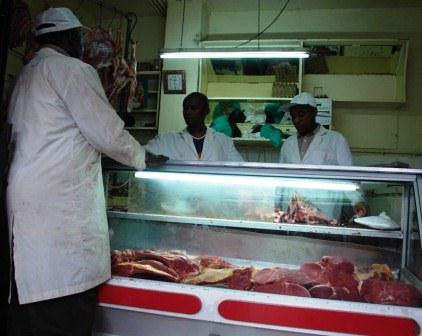
Selling meat in a Kenyan butchery. Improving the quality and safety of beef sold by small-scale traders in East Africa will enable them take advantage of emerging niche markets and increase their incomes. (Photo: ILRI)

According to a May 2011 report by the International Food Policy Research Institute (IFPRI), annual meat consumption per person will more than double in sub-Saharan Africa from 2000 to 2050, leading to a doubling of total meat consumption by 2050.

The Food and Agriculture Organization (FAO) estimates that between 1997-99 and 2030, annual meat consumption in sub-Saharan Africa (excluding South Africa) will increase from 9.4 to 13.4 kg per person.

Growth in human population, increasing incomes and changing consumer tastes are among the main drivers of this rise in demand for high-quality meat products in much of the developing world, a trend that is expected to continue.

In eastern Africa, the growing demand for high-quality meat products presents a ripe opportunity for livestock producers to take advantage of the emerging markets for value-added meat products. However, several institutional barriers, such as unfavourable policies and poorly enforced regulations, limit the extent to which small-scale meat producers and market agents in the region can benefit from these opportunities.

To address this and other related issues, a collaborative project, Exploiting market opportunities for value-added dairy and meat products in the Eastern and Central Africa region, was carried out in Ethiopia, Kenya and Tanzania in 2006 and in Rwanda, Uganda and South Sudan in 2010 to characterize value chains for conventional and niche markets for dairy and meat products.

The project aimed at enhancing the capacity of small- and medium-scale enterprises in the East Africa region to effectively meet consumer demand for safe, high-quality dairy and meat products that meet national regulatory requirements.

The study examined consumers' perspectives on meat quality and safety and found that high-income consumers prefer to buy meat from upper-end markets like priority stores and supermarkets. They associate well packaged meat, clean premises and veterinary stamped-products with good quality and safety, and are indeed willing to pay a premium for these attributes. On the other hand, low-income consumers mostly purchase their meat products from local butcheries.

Roast beef

Selling of roast beef is an increasing trend motivated by rising consumer demand for ready-to eat roast beef. For example, in Kenya, Tanzania and South Sudan, the roast meat (nyama choma) sold in butcheries and bars is a growing preference by both the indigenous and foreign consumers. In Uganda, vending of roadside roast beef known as muchomo is a growing trend on highway spots outside the capital city, Kampala.

The different ways in which the beef is roasted, dressed and sold varies by country. However, some consumers still question the safety and quality of beef as it goes through the processes of roasting, dressing and selling. However, if sellers can provide assurance of quality and safety then there will be demand from the high-income consumers.

Therefore, to increase the sales of value-added products, sellers of roast beef should adhere to national regulations for quality and safety and respond to consumer preferences. The growing trend of niche markets running along the spectrum of high, medium and low income consumers should also be explored as an opportunity for increasing sales through product value addition.

Regulators and policy perspectives

With regard to the policy and regulatory environment, the study identified a need for greater harmonization of regulations among countries in the eastern Africa region in order to enhance effective service provision to the beef sector.

The study proposes that a comprehensive beef policy for the region be drawn up to guide the implementation and enforcement of regulations aimed at ensuring the quality and safety of beef products, particularly those sold by small-scale traders.

For more information about this study, please contact Dr Amos Omore of the International Livestock Research Institute (ILRI) (a.omore @ cgiar.org).

Story adapted from a brochure, Quality and safety of small-scale beef products in East and Central Africa, produced by the Association for Strengthening Agricultural Research in Eastern and Central Africa (ASARECA).

Kamis, 23 Desember 2010

ILRI report quantifies demand for improved quality and safety of livestock products among urban Bangladeshi consumers

Abstract
Demand for animal products has been increasing rapidly in Bangladesh due to urbanization and increases in per capita income.

There are rudimentary indications that demand for improved food quality and safety has also been increasing and that consumers were willing to pay higher prices for such attributes of products.

However, there is little empirical evidence on the criteria and indicators of quality and safety that consumers use in their buying decisions, or that suppliers use in differentiating products to promote sales, or the extent to which consumers are willing to pay for such attributes.

This study is the first attempt to comprehensively characterize and quantify Bangladeshi urban demand for animal products with a focus on quality and safety.

Based on a multi-stage sample survey of 900 households from Dhaka and Mymensingh cities, successive analyses present statements of preference based on ratings, identified quality criteria, stated sources of supply and recent purchasing behaviour both at home and away from home, and econometric analysis of relationships between price ratings and quality ratings across attributes, so as to generate willingness to pay for those attributes.

The findings show that officially defined grades and quality standards of livestock products are either absent or poorly defined and enforced.

On the other hand, producers and consumers in the market use specific attributes or criteria and indicators to differentiate quality and safety of livestock products and they also charge and pay different prices based on those attributes.

Although targeted at urban populations, considerable variation between locations in terms of the product preferences and attributes used to differentiate quality was identified.

Establishment of standards and grades will become necessary to meet consumer demand on the one hand and facilitate producers and market agents to respond to consumer demand on the other.

Whether smallholders will have any comparative advantage in supplying an expanding market requiring more homogenous and better quality and safer products need to be studied regularly along with studies on consumer demand because of the dynamic nature of the emerging and evolving market, the industry and the sector.

Access the full report here.

Citation:
Islam SMF and Jabbar MA. 2010. Consumer preferences and demand for livestock products in urban Bangladesh. ILRI Research Report No. 23. ILRI (International Livestock Research Institute), Nairobi, Kenya.

ILRI research report features case studies on consumer demand for livestock products in Africa and Asia

Abstract
Rising developing country demand for livestock products propelled by income and population growth, and by urbanization offers poverty reduction opportunities to actors in the supply chain.

The increase in volumes demanded also features diversification and increased demand for quality attributes. Reliable food safety and information on animal husbandry and geographic origin have long been recognized as value-adding differentiation mechanisms in the developed world.

Anecdotal accounts suggest that this is also the case in developing countries.

However, little consistent rigorously researched evidence has been published on this subject.

This report presents results based on case studies conducted in a number of developing countries in Asia and Africa: Bangladesh, Cambodia, Ethiopia, India, Kenya, Tunisia, and Vietnam.

An overview of the theoretically consistent methods used and a synthesis of the results obtained in the various case studies are presented first followed by the case studies each describing a study of specific commodities in specific developing country locations.

A consistent set of results emerges, wherein consumers exhibit willingness to pay for quality and safety in animal-origin foods, and within which this willingness to pay is strongest amongst the wealthy and the urban dwellers.

However, the intricacy and variety of quality definition and measurement are demonstrated fully, as they occur between and within countries, commodity groups and other settings.

The key message from the results is the evidence that quality and safety considerations in products of animal origin food provide commercial opportunities for developing country producers, market actors and industry participants.

Access the full report here.

Citation:
Jabbar MA, Baker D and Fadiga ML. (eds). 2010. Demand for livestock products in developing countries with a focus on quality and safety attributes: Evidence from Asia and Africa. ILRI Research Report No. 24. ILRI (International Livestock Research Institute), Nairobi, Kenya.

Kamis, 17 Juni 2010

New journal article: Consumer demand for sheep and goat meat in Kenya


A recently published study on consumer demand for sheep and goat meat in Kenya has found that a niche market exists for these products among consumers in two key production and market locations in the country.

The study, published in an article in the May 2010 issue of Small Ruminant Research, sought to investigate patterns of consumption of small ruminants' meat in Kenya and the factors influencing consumer demand for these products.

Data from 103 households were collected in Marsabit  District, a semi-arid region where small ruminant production is a major economic activity, and Kiamaiko area in the capital city Nairobi, a key market for sheep and goats from Marsabit.

Over 55 per cent of sampled households preferred sheep and goat meat over beef. Purchase price of small ruminant meat, household location, and share of monthly income spent on food were among the factors identified to play a role in influencing consumer demand for sheep and goat meat.

Producers need to be aware of the existing and potential demand for sheep and goat meat so as to be able to respond appropriately to consumers' needs and ensure access to markets, the authors conclude.

Dr Isabelle Baltenweck, an agricultural economist with ILRI's Markets Theme, is a co-author of the journal article.

Read the abstract here.

Citation:
Juma GP, Ngigi M, Baltenweck I and Drucker AG. 2010. Consumer demand for sheep and goat meat in Kenya. Small Ruminant Research 90(1-3): 135-138.

Kamis, 25 Februari 2010

Vietnam pork sector study featured in New Agriculturist

A collaborative study led by ILRI's Markets Opportunities theme to map the supply chains for pigs and pork products in Vietnam is featured in the January 2010 issue of the online bimonthly newsletter New Agriculturist.

The project, Improving the competitiveness of pig producers in an adjusting Vietnam market, is aimed at generating research evidence to inform policymakers on the appropriate policy, technological and institutional frameworks that will allow Vietnam's smallholder pig producers to competitively increase their incomes through enhanced access to market chains for high-value pork products.

"Smallholders could play a much greater role in pork production but there is a need to generate appropriate technologies to maximise the potential of these systems, to improve the breeds and to provide better and more cost-efficient feed rations," the article quotes Lucy Lapar, ILRI Markets Theme scientist and project coordinator.

The project is due to end in March 2010 but it is hoped that the outputs of the study will be taken up by policymakers and sector stakeholders to inform dialogue towards formulation of pro-poor policies in support of Vietnam's smallholder pig producers.

The project is funded by the Australian Centre for International Agricultural Research (ACIAR) in collaboration with the Centre for Agricultural Policy - Institute of Policy and Strategy for Agricultural and Rural Development (CAP-IPSARD), the International Food Policy Research Institute (IFPRI), Oxfam and the University of Queensland.

Here's the link to the New Agriculturist article, Vietnam: taking a pig to market.

Selasa, 01 Desember 2009

ILRI research report: Improving smallholder farmers' marketed supply and market access for dairy products in Arsi Zone, Ethiopia


ILRI's Market Opportunities Theme has this month (December 2009) released a report of a comprehensive study of dairy supply and demand, and the role of collective action in enhancing market access by smallholder milk producers in Arsi Zone, Ethiopia.

The report was written by Asfaw Negassa, an agricultural economist formerly with ILRI's Market Opportunities theme and currently with the International Food Policy Research Institute (IFPRI), Addis Ababa, Ethiopia.

The study identified key supply- and demand-side strategic interventions that may improve the productivity and market orientation of smallholder dairy producers in Ethiopia's Arsi Zone. Strategic collective action interventions are also suggested.

Some of the proposed interventions are: improving availability and utilization of fodder; improving access to animal health services; providing smallholder dairy farmers with access to credit; enhancing horizontal integration of milk marketing co-operatives; and providing a variety of high-quality, safe dairy products to consumers at competitive prices.

Download the PDF document (564 KB)

Citation:
Negassa A. 2009. Improving smallholder farmers' marketed supply and market access for dairy products in Arsi Zone, Ethiopia. Research Report No. 21. ILRI (International Livestock Research Institute), Nairobi, Kenya. 107 pp.

Senin, 30 November 2009

ILRI research report: Constraints in the market chains for export of Sudanese sheep and sheep meat to the Middle East


Livestock exports are the second most important source of foreign exchange in Sudan after oil. The Middle East, especially Saudi Arabia, has been the traditional export destination for Sudan’s livestock and livestock products.

However, while these Middle Eastern markets have a specific preference for mutton from Sudan's natural grass-fed sheep, competition from new markets like Australia, Brazil and New Zealand coupled with constraints within the supply chains for sheep and sheep meat have set Sudan's market share on a downward trend.

Research by ILRI and partners from Sudan's Ministry of Animal Resources and Fisheries, and the University of Khartoum was carried out to characterize the nature of these market constraints.

The study findings are contained in a report titled Constraints in the market chains for export of Sudanese sheep and sheep meat to the Middle East.

Distant supply hinterlands, poor road networks, low market offtake rates, poor access to animal health facilities and deficient quality assurance systems were identified as the main market barriers.

The authors make several recommendations for improving the efficiency of the market chain and for future research. These include branding and promotion of Sudanese sheep and mutton; more rigorous application of animal/meat inspection and certification; and increased access to credit for livestock keepers.

Download the PDF document (365 KB)

Citation:
el Dirani OH, Jabbar MA and Babiker IB. 2009. Constraints in the market chains for export of sheep and sheep meat to the Middle East. Research Report No. 16. Department of Agricultural Economics, University of Khartoum, Khartoum, the Sudan and ILRI (International Livestock Research Institute), Nairobi, Kenya. 93 pp.

Senin, 13 Juli 2009

ILRI paper wins top award at IAMA World Annual Symposium

An ILRI research paper on commodity-based beef exports from Ethiopia won the Best Paper Award at this year’s World Annual Forum and Symposium of the International Agribusiness Management Association (IAMA) held at Budapest, Hungary from 20-23 June 2009.

The paper, titled Commodity-based trade and market access for developing country livestock producers: the case of beef exports from Ethiopia, came out tops in a field of 29 papers that were up for the award. Over 350 people attended the symposium whose theme, in relation to food and agribusiness, was Global challenges and local solutions.

The paper was written by Karl Rich of ILRI and the American University in Cairo, and two former ILRI (and Markets theme) staff: Brian Perry of the University of Oxford and Simeon Kaitibie of the International Centre for Agricultural Research in the Dry Areas (ICARDA), Syria.

The paper examines the economic feasibility of a proposed two-phase SPS (sanitary and phytosanitary) certification for beef exports as a means of enhancing Ethiopian livestock exports.

“Given the nature of competition in international beef markets, Ethiopia will likely be forced to compete on quality, exporting a diversity of cuts on the basis of demand and competitiveness in different regions, and in differentiating its product relative to competitors over and beyond higher disease-free and food safety standards,” the paper concludes.

Download the paper here (PDF)